The Euro after trading as high as 1.0828 against the US Dollar this past week found resistance.
The EURUSD pair moved down, and broke a major bullish trend line at 1.0700 on the 4-hours chart.
The Import Price Index released by the US Department of Labor in the US posted an increase of 0.4% in Jan 2017, more than the 0.2% forecast.
The US Export Price Index came in at 0.1%, just as the market expected in Jan 2017.
EURUSD Technical Analysis
The Euro came under bearish pressure this past week above the 1.0800 level against the US Dollar. The EURUSD pair moved down, and now looks set for more declines.The 4-hours chart of EURUSD suggests that the pair broke a major bullish trend line at 1.0700, which ignited a downside move. Moreover, the pair also cleared the 100 simple moving average on the same chart, which is a bearish sign.The pair traded as low as 1.0607, and currently consolidating losses. Any rallies from the current levels may face sellers near the trend line resistance. Moreover, the 200 simple moving average on the same chart at 1.0640 could also act as a barrier for an upside move in EURUSD.
US Import and Export Price Index
Recently in the US, the Import Price Index, which informs the changes in the price of imported products into the US was released for Jan 2017 by the US Department of Labor. The forecast is slated for an increase of 0.2% in Jan 2017, compared with the previous month.However, the result was better, as the Import Price Index rose 0.4%. On the other hand, the US Export Price Index came in at 0.1% in Jan 2017, compared with the previous month. This was in line with the forecast.The report added that “For both months, a rise in fuel prices more than offset declining nonfuel prices. Prices for U.S. exports advanced 0.1 percent in January, after rising 0.4 percent the previous month“.Overall, the market looks like not favoring the Euro at the moment, which may ignite more losses in EURUSD towards 1.0550. Selling rallies may be preferred in the short term.

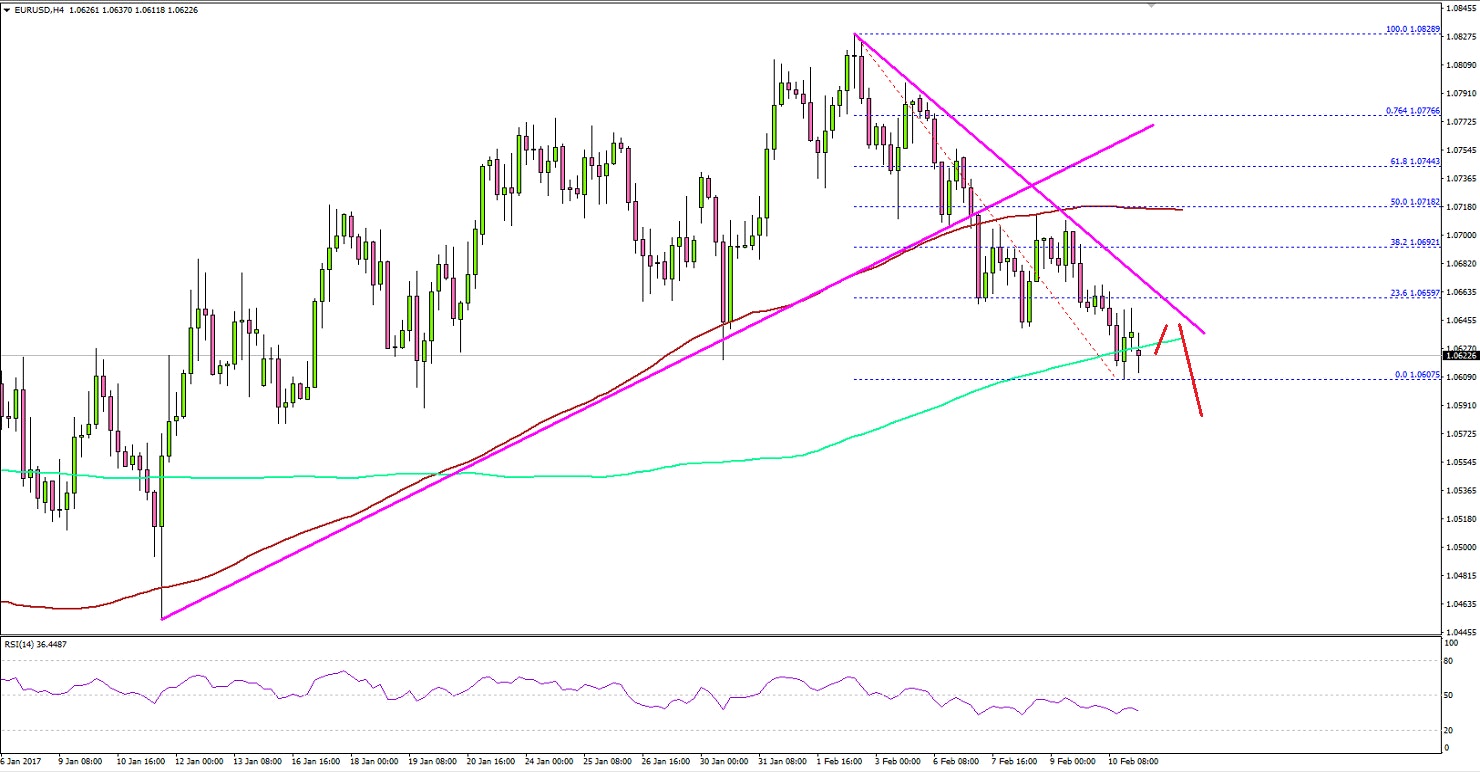 The 4-hours chart of EURUSD suggests that the pair broke a major bullish trend line at 1.0700, which ignited a downside move. Moreover, the pair also cleared the 100 simple moving average on the same chart, which is a bearish sign.The pair traded as low as 1.0607, and currently consolidating losses. Any rallies from the current levels may face sellers near the trend line resistance. Moreover, the 200 simple moving average on the same chart at 1.0640 could also act as a barrier for an upside move in EURUSD.